Credit: Getty Images
The César Chávez Reckoning Is Showing America What Accountability Actually Looks Like
By Yamily Habib
In the United States, powerful men usually get years of deflection, euphemism, strategic silence, sealed files, procedural fog, and institutions pretending they need just a little more time before they can say the obvious out loud. The Jeffrey Epstein scandal is the clearest example. It has produced millions of pages, congressional subpoenas, briefings, and a Reuters/Ipsos poll showing Americans broadly believe the powerful rarely face accountability. But it still has not delivered the kind of immediate, public symbolic reckoning that people keep insisting is impossible.
But then, when it happens inside the Latino community, the response is radically different.
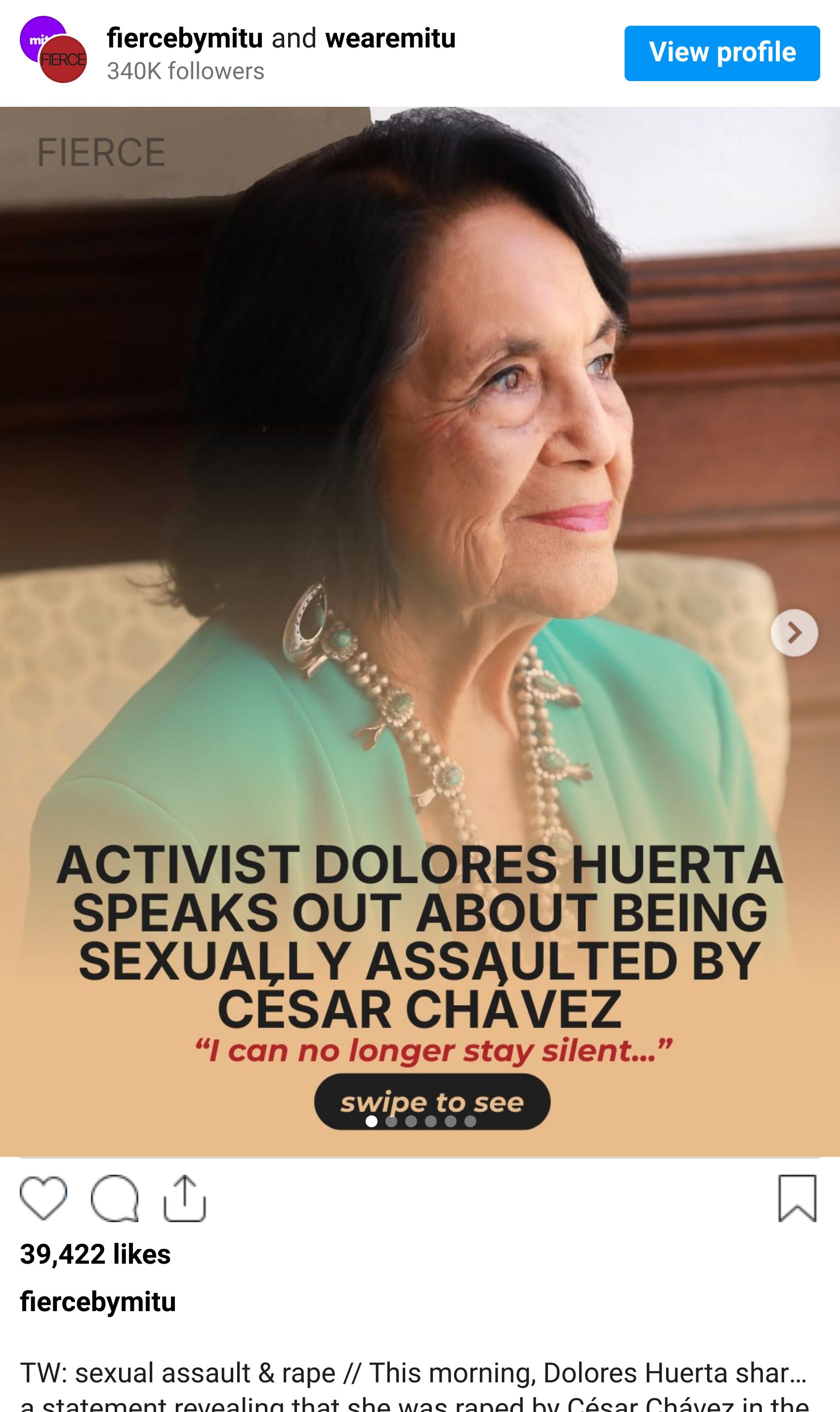
Within hours of Dolores Huerta publicly confirming that César Chávez sexually abused her, and after The New York Times investigation laid out additional allegations involving women and girls, the reaction was not to protect the brand at all costs. It was to start pulling his name off the pedestal.
According to NBC Los Angeles, Los Angeles County Supervisor Hilda Solis moved to explore renaming the county holiday and “all county assets” that recognize Chávez. Similarly, according to the Los Angeles Times, officials across California began reevaluating schools, streets, parks, statues, and civic events bearing his name. Fresno State moved to remove its Chávez statue. UC Davis renamed a conference. Local leaders proposed replacing César Chávez Day with Farmworkers Day.
That response says something important about where our community chooses to stand in the incongruous battle of right vs. wrong.
The César Chávez fallout moved faster than powerful America usually does
What’s more, it gives us a glimpse of how things should be.
According to KOAT, New Mexico Gov. Michelle Lujan Grisham called the allegations “shocking and horrifying” and backed “a full and thorough investigation.” Zachary Quintero of the National Hispanic Cultural Center told the station, “We’re shocked and horrified,” then added, “One man does not reflect an entire movement.”
According to NBC Los Angeles, Karen Bass said she was keeping “Dolores Huerta, Ana Murguia, and Debra Rojas in my heart.” At the same time, Janice Hahn joined the argument that it was time to change the county holiday to “Farmworker Day.” CHIRLA stated that “no individual person, regardless of their stature, is above accountability.” The Congressional Hispanic Caucus went even further: “Accountability never dies.”
According to the Los Angeles Times, California Rising founder Raul Claros launched a petition to rename Cesar E. Chavez Avenue in Los Angeles to Dolores Huerta Avenue. Fresno City Councilmember Miguel Arias said public spaces should honor people who represent “the highest values” of the community and that, given what is now known, “we have a responsibility to act accordingly.” He then added: “When the abuelita sits you down at the dinner table and tells you the truth about what happened back in the days, we have a responsibility to listen and to act.”
And no, this is not about circling the wagons. It is how our community immediately chooses to move forward, with accountability.
Even the comments on social media told the same story. “This is why it’s so important that we don’t consider a movement to be founded by only one leader. I believe Dolores Huerta and I stand with farmworkers; que siga la lucha,” one person wrote. Another said, “Petition to rename every Cesar Chavez street to Dolores Huerta.” Similarly, another added: “Believe women.” Another: “Let’s rename every school and street to Delores Huerta!”
You can call that symbolic, and it is. But symbols are the architecture of public memory. Streets, statues, school names, and holidays tell people who a community has decided to honor. But more than anything, it tells you the steeled backbone of the Latino community.
The César Chávez reckoning is also about who we choose to protect
For decades, Latino communities have had to hear lazy outside narratives about machismo as if patriarchy were somehow our uniquely ethnic flaw, rather than one of the foundational operating systems of the entire country. But what this moment shows is almost the opposite. When the truth is out in the open, Latino institutions are not uniquely incapable of moral clarity. In several cases, they are showing more of it than the broader U.S. political culture usually does.
In a crucial historical moment, that contrast is hard to miss. The Epstein files saga continues to churn through Washington with subpoenas, closed-door briefings, accusations of redaction and withholding, and fresh questions about elite ties, including renewed scrutiny around Donald Trump’s past relationship with Epstein. Yet the broader American system still looks stuck; we don’t know where, exactly.
Meanwhile, in this case, the first instinct from many Latino leaders and organizations was not, “let’s wait until the optics improve.” It was, “we stand with survivors, and we need to rethink what and who we commemorate.”
That stark difference shows a refusal to confuse movement loyalty with impunity. It shows a refusal to treat a man’s symbolic value as a shield against moral judgment. And it shows something else too: a lot of people already knew the old model was unsustainable. The comments calling for Dolores Huerta’s name to replace Chávez’s emerged from years of watching women hold movements together while men got mythologized as if they built history alone.
The community response around César Chávez keeps making one point
One man does not own the movement.
According to NBC Los Angeles and the Los Angeles Times, Los Angeles Unified is reviewing its curriculum. Hence, the emphasis remains on “the important work of the farmworker movement, not on any one individual.” LULAC said, “The actions of one person neither reflect nor diminish the integrity of the farmworker movement.” Aquí: The Accountability Movement said, “The farmworkers movement is a collective.”
In the end, this is not just a fall-from-grace narrative about César Chávez. It is a power shift in how memory works. The old version of Latino political storytelling relied heavily on singular male heroes. The newer version looks more skeptical, more collective, and far less willing to sacrifice women to preserve a monument.
That does not mean the community is perfect. It means the community is showing up and rising to the challenge.
And right now, that work looks like this: believe Dolores Huerta. Protect the movement from the man, not the man from the truth. Rename the street if you have to, cover the statue, rewrite the curriculum. Stop pretending accountability dies when the accused does.
Because, in this case, the Latino community is not asking whether the legacy belongs to a single name. It is asking a much more important question: If public honor is supposed to reflect public values, then why should César Chávez keep his name on everything while Dolores Huerta had to keep his secret for sixty years so we could have the rights we have?
Join the mitú fam
Follow us to connect with our community and see how Latinos are shaping culture every day.